2024-06-16 by Shakunthala Natarajan
Why Do We Brush Our Teeth? | Science Blog

It’s another sunny morning and you are brushing to get ready for the day. As you watch the lather and bubbles form in your mouth with the toothpaste swishing and engulfing the teeth, you start wondering, ‘why do we brush?’. Utsuka and Jigyasa, our explorer duo, are also as curious as you to find the answer to this question. Let us join hands together and traverse the oral world along with the duo, in this episode of IndiaAsksWhy.
Teeth are the entry line soldiers of our body harbouring beneficial microbes that perform important functions. Teeth have a hard covering or coating called ‘enamel’. Do you know that enamel is the hardest substance present in our entire body?:) Now, let’s come back to the question, ‘why should we brush?’, and why is just gargling not enough.
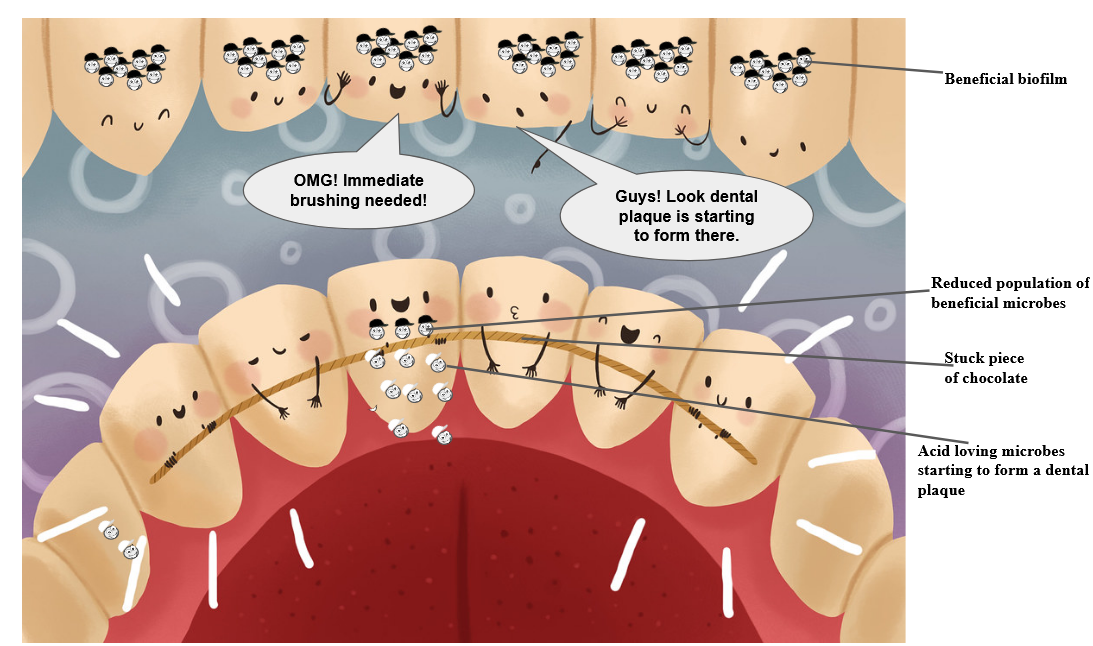
The microbes present on teeth are present as ‘biofilms’ on the teeth surface. There are more than 700 species of microbes that are found in oral biofilms. You will be surprised to know that this number is only second to the number of microbes found in a human gut! A biofilm can be imagined as a thin cloth in which the resident microbes are studded and survive as closely knit, sharing and caring communities. These magic cloths, mostly composed of beneficial microbes that cover our teeth, play an important role in immune protection and also help ward off harmful germs. The microbes in the biofilm share food, warning signs of intruders and more information through the matrix that connects them. They are thus in symbiosis among themselves, as well as with the human, whose oral system shelters them. Moreover, not all microbes come together to live in the biofilm mode of life. Only those microbes that get along well with the teeth microenvironment form these biofilms.
So far peace and harmony prevail in the tooth biofilm community. But the moment, say a chunk of sweet like chocolate is bitten, bits of chocolate stick to the teeth. Now the microbes are in for a sugary treat! They digest the sugar molecules, convert them into acids and release them into the matrix. This acid signal attracts more acid-loving bacteria to the site. The new guests also feed on the sugar and produce more acids. The peaceful biofilm made of beneficial microbes gets disrupted and acid-loving microbes start to dominate, forming what is called a ‘dental plaque’. The benefical microbes are present in minority in such dental plaques and the acid-producers comprise the majority. These acid producers secrete acids that are corrosive enough to form holes on the tooth enamel! These holes are scientifically called ‘cavities’. The dental cavities are thus caused by an imbalance of the microbes in the teeth biofilm. Brushing removes food particles like chocolate, other carbs and sugars stuck to the teeth. It also physically disrupts the biofilm matrix after which only the regular residents or beneficial microbes re-group to form the protective biofilm.
Utsuka and Jigyasa are awestruck by the power of these tiny microbes and want to know how these microbes are studied by scientists to understand their roles and functions. They call upon Dr Karishma Kaushik, a physician turned researcher to gather more insights on how oral microbiome is studied. Let us tag along with them.
Dr Kaushik’s lab studies the role of biofilms in infectious diseases. With her rich expertise in the area, she explains that they closely study the microbiome composition of cavities, and pick up a few relevant and more important microbes from prior research work. They then grow these microbes in plastic dishes, and expose them to conditions that are normally encountered in a human mouth. For instance, people eat chocolate fruits, and drink coffee. These are basically sources of sugar, hence they feed the microbes in the lab with sugar sources. Then they observe how these microbes respond to these external factors while being present as a biofilm.
Utsuka, Jigyasa, and you too must have got a good understanding of the tiny microbes present on our teeth. Moving on, more importantly, we also looked at why it is necessary to brush our teeth. I bet you would want to know more about the scientific secrets of the oral world by directly joining Utsuka and Jigyasa in their adventure by tuning into the podcast. It’s now time to gear up your headphones, listen to our podcast, learn more and increase your curiosity limits! Happy sciencing:)
References
- Admin (2023) Brushing your teeth, why, when and how -, Larkham House Dental Practice | Dentist in Larkham Lane, Plymouth. Available at: https://larkhamhouse.co.uk/brushing-your-teeth-why-when-and-how/ (Accessed: 24 February 2024).
- Barbe, A.G. et al. (2021) ‘Effectiveness of brushing teeth in patients with reduced oral hygiene by laypeople: A randomized, controlled study’, BMC Oral Health, 21(1). doi:10.1186/s12903-021-01590-4.
- Henriques, M. (2022) The best way to brush your teeth, BBC News. Available at: https://www.bbc.com/future/article/20220718-the-best-way-to-brush-your-teeth (Accessed: 24 February 2024).
- For thousands of years, humans did not brush their teeth. why do we brush them now?, Jocelyn L. Anderton DMD, LLC. (2016) Available at: https://andertondentistry.com/for-thousands-of-years-humans-did-not-brush-their-teeth-why-do-we-brush-them-now/ (Accessed: 24 February 2024).
Cover image credit: Image by Steve Buissinne from Pixabay
tags: